You step into an intersection with no painted lines, no flashing signals, and no sign telling drivers to stop. To most people, it looks like there is no crosswalk at all. Then a car drives straight through and hits you.
The question that follows is critical: was the driver legally required to stop?
Under California law, the answer is yes. But most drivers, and even many pedestrians, do not understand this rule until it is too late. That confusion is often exactly what leads victims to seek guidance from a California pedestrian accident lawyer.
This guide explains how California’s unmarked crosswalk laws actually work, what CVC 21950 requires from both drivers and pedestrians, when fault may be shared, and what legal options you have after a pedestrian accident at an unmarked intersection.
BY THE NUMBERS
| 928 | 26% | 77% |
| Preliminary California pedestrian fatalities in 2024 (GHSA) | Share of all California traffic deaths that were pedestrians in 2022 (UC Berkeley)—more than double the national share | Of California pedestrian deaths, with known lighting conditions, occurred after dark (GHSA 2024) |
What Is an Unmarked Crosswalk Under California Law?
Most people picture a crosswalk as a painted stripe across a road. California law goes significantly further. Under California Vehicle Code Section 275, a crosswalk is defined as either:
- The portion of a roadway included within the prolongation or connection of the boundary lines of sidewalks at intersections where the intersecting roadways meet at approximately right angles, or
- Any portion of a roadway distinctly indicated for pedestrian crossing by lines or other markings on the surface.
The first definition is the one that trips most people up. It means that almost every intersection where two roads meet creates a legal crosswalk, whether or not any paint, reflectors, or signage exist. If there is a sidewalk or the edge of a curb on both sides of the street, the implied extension of that pathway across the intersection is a crosswalk under California law.
An unmarked crosswalk is that implied crossing. It has the same legal status as a painted crosswalk for the purpose of pedestrian right of way. It differs only in that it may be harder to see, which is precisely why California law places the primary duty of care on the driver, not the pedestrian.
| Where Unmarked Crosswalks Do NOT Exist. Not every point where a pedestrian might cross a road is a legal crosswalk. An unmarked crosswalk only exists at an intersection. Crossing mid-block is not covered by CVC 21950. That falls under the Freedom to Walk Act (CVC 21955, effective January 1, 2023), which decriminalized jaywalking when it can be done reasonably safely. |
CVC 21950: The Full Text and What It Actually Means
California Vehicle Code Section 21950 is the statute that governs pedestrian right of way at crosswalks, marked and unmarked. Here is the operative text as of its most recent amendment (effective January 1, 2023):
| CVC § 21950 — PEDESTRIAN RIGHT OF WAY (a) The driver of a vehicle shall yield the right-of-way to a pedestrian crossing the roadway within any marked crosswalk or within any unmarked crosswalk at an intersection, except as otherwise provided in this chapter. (b) This section does not relieve a pedestrian from the duty of using due care for their safety. No pedestrian may suddenly leave a curb or other place of safety and walk or run into the path of a vehicle that is so close as to constitute an immediate hazard. No pedestrian may unnecessarily stop or delay traffic while in a marked or unmarked crosswalk. (c) The driver of a vehicle approaching a pedestrian within any marked or unmarked crosswalk shall exercise all due care and shall reduce the speed of the vehicle or take any other action relating to the operation of the vehicle as necessary to safeguard the safety of the pedestrian. (d) Subdivision (b) does not relieve a driver of a vehicle from the duty of exercising due care for the safety of any pedestrian within any marked crosswalk or within any unmarked crosswalk at an intersection. |
Three obligations stand out. Drivers must yield when a pedestrian is crossing at any intersection. Drivers must exercise due care and reduce speed when approaching a pedestrian in any crosswalk. Also, while pedestrians have the right of way, they cannot dart into traffic so close that a collision is unavoidable, nor deliberately slow traffic without reason.
Subsection (d) is the one most drivers overlook: even if a pedestrian breaks the rules under subsection (b), the driver still has a legal duty of due care. Right-of-way violations by pedestrians reduce compensation under comparative negligence; they do not eliminate the driver’s legal obligations.
Driver Obligations at Unmarked Crosswalks
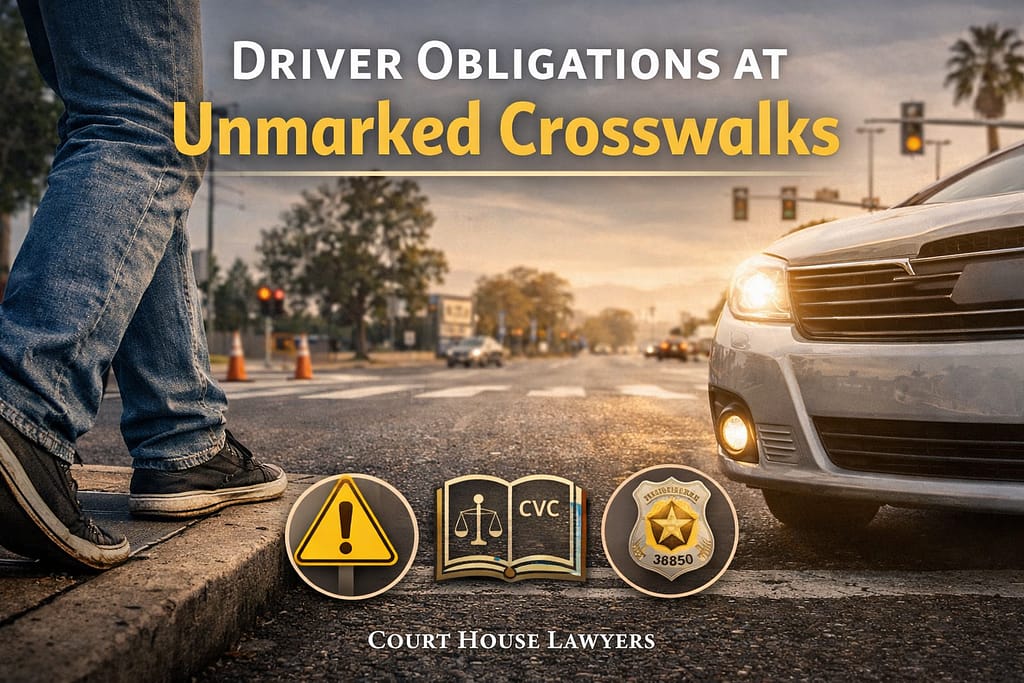
California’s framework under CVC 21950 is more demanding than many drivers realize. Yielding is not simply slowing down as you pass a pedestrian; it means giving the pedestrian the right to cross safely before you proceed.
The “All Due Care” Standard
CVC 21950(c) requires drivers to exercise “all due care”, not just awareness, but active protective action. California courts have held that speeding up to beat a pedestrian to an intersection, failing to check for pedestrians before proceeding through an uncontrolled intersection, and ignoring a pedestrian who has already stepped into the crosswalk all constitute failures of due care.
Multi-Lane Intersection Rule
Under CVC 21951, a driver approaching a vehicle that has stopped at an intersection to allow a pedestrian to cross shall not pass the stopped vehicle until the pedestrian has cleared the lane. Drivers in adjacent lanes cannot simply continue at speed because another lane has stopped.
The Daylighting Law (AB 413, Effective January 1, 2025)
AB 413, California’s “daylighting” law, prohibits parking within 20 feet of the approach end of a crosswalk. Parking in violation of AB 413 in a way that obstructs visibility can itself be evidence of negligence in a California pedestrian accident claim.
| Failure to Yield Is a Traffic Violation and Evidence of Negligence. A driver cited under CVC 21950 for failing to yield to a pedestrian in an unmarked crosswalk can face a fine, a DMV point, and critically, that citation is admissible as evidence of negligence per se in any resulting personal injury claim. This is one of the reasons documenting a police report immediately after a crosswalk accident is essential. |
Pedestrian Obligations: Right of Way Is Not Unconditional
California’s pedestrian right-of-way is strong but not absolute. CVC 21950(b) imposes specific obligations on pedestrians, and violating them can reduce, though not eliminate, their compensation in a California pedestrian accident case under the state’s pure comparative fault rules.
What Pedestrians Cannot Do
- Dart into traffic: No pedestrian may suddenly leave a curb and enter the path of a vehicle close enough to constitute an immediate hazard. A pedestrian who steps off the curb with adequate warning time for traffic is not darting.
- Unnecessarily delay traffic: Stopping in a crosswalk to check a phone or lingering without reason violates CVC 21950(b). This can be used to assign partial fault in a personal injury case.
- Cross outside intersections without care: Mid-block crossings fall outside CVC 21950’s protections. Under the Freedom to Walk Act, jaywalking is decriminalized when reasonably safe, but a pedestrian injured mid-block will face a harder comparative fault argument.
California’s Pure Comparative Fault Standard
California applies pure comparative negligence, meaning a pedestrian can be 30%, 50%, or even 80% at fault and still recover the remaining percentage of their damages. A pedestrian found 25% at fault still recovers 75% of the total damages from the driver. This is a significant protection compared to contributory negligence states, where any fault can bar recovery entirely.
Understanding how liability is apportioned matters deeply in cases with car accidents involving pedestrians; the split between driver negligence and pedestrian conduct is often contested aggressively by insurers.
Marked vs. Unmarked Crosswalks: Key Legal Differences
The legal right-of-way is the same in both marked and unmarked crosswalks. However, the practical and evidentiary differences can significantly impact how a case is argued and proven in litigation:
| Factor | Marked Crosswalk | Unmarked Crosswalk |
|---|---|---|
| Driver duty to yield | Yes — CVC 21950(a) | Yes — CVC 21950(a), same standard |
| Visual notice to the driver | High — paint, reflectors, sometimes signals | None — driver must use due care |
| Negligence per se argument | Stronger — clear visible warning ignored | Still viable — driver has statutory knowledge of CVC 21950 |
| Pedestrian visibility risk | Lower — pedestrian in designated zone | Higher — especially at night or in low-light conditions |
| Mid-block applicability | Yes — can exist mid-block | No — only at intersections |
| Insurance dispute likelihood | Moderate | High — insurers frequently argue that crossing was not designated |
The most common insurer tactic in unmarked crosswalk claims is to argue the pedestrian was not legally crossing at a designated location. This argument fails under CVC 21950 and CVC 275 when the crossing occurred at an intersection, but insurers raise it routinely to discourage unrepresented claimants.
Common Scenarios and Who Is at Fault
Scenario 1: Driver runs through an uncontrolled intersection
A pedestrian steps into the unmarked crosswalk with enough time for a reasonable driver to stop. The driver does not stop and strikes the pedestrian.
Result: Driver bears primary or exclusive liability under CVC 21950(a). No paint was required; the legal duty existed at the intersection.
Scenario 2: Pedestrian steps off the curb into moving traffic
A pedestrian steps into the intersection without looking, directly into the path of a vehicle traveling at 35 mph with less than one second of reaction time.
Result: Shared fault is likely. The pedestrian may be assigned significant comparative fault under CVC 21950(b). The driver may still bear some fault if speed or inattention contributed.
Scenario 3: Multi-lane road; one driver stops, adjacent lane does not
A pedestrian receives a wave from a stopped driver, begins crossing, and is struck by a vehicle in the adjacent lane.
Result: The striking driver is liable under CVC 21951. The pedestrian bears limited comparative fault for not checking the adjacent lane, often assessed at a low percentage.
Scenario 4: Nighttime crossing; pedestrian not visible
77% of pedestrian deaths with known lighting conditions occurred after dark. A driver striking a pedestrian at night must show they were driving at a speed appropriate for visibility conditions, not simply the posted speed limit. Driving the speed limit does not discharge the “all due care” standard if the stopping distance exceeds visibility range.
Scenario 5: Parking obstruction blocks visibility
A vehicle parked within 20 feet of a crosswalk blocks the driver’s view of the pedestrian. Under AB 413, the parked vehicle is in violation. The parked vehicle’s owner, the driver, and potentially the municipality may all share liability.
| Note on Rideshare Accidents Pedestrian accidents involving Uber or Lyft add complexity because multiple insurance policies may apply depending on whether the driver was carrying a passenger or waiting for a ride. Understanding how to prove fault in rideshare pedestrian accidents in Los Angeles requires knowing which insurance tier was active at the time of impact. |
What to Do After a California Pedestrian Accident at an Unmarked Crosswalk
The steps you take in the hours and days after a California pedestrian accident directly affect the strength of any legal claim. Insurance companies begin their investigation immediately—yours should too.
- Call 911 and get a police report filed. Even if injuries seem minor, a police report creates an official record of the location, driver information, witness names, and the officer’s preliminary assessment of fault. At an unmarked crosswalk, this documentation is especially important because the location itself will be disputed.
- Photograph the intersection extensively. Document every angle, the lack of markings, the sidewalk lines on both sides showing the implied crosswalk extension, any parked cars within 20 feet, traffic signage, and road conditions. This evidence is often not preserved by law enforcement.
- Gather witness contact information. Bystander testimony at an unmarked crosswalk can be decisive. Get names and phone numbers before anyone leaves the scene.
- Seek immediate medical attention even without obvious symptoms. Internal injuries, traumatic brain injuries, and spinal injuries frequently do not produce immediate pain right away. A same-day medical evaluation creates both a health record and a legal record tying your injuries to the accident.
- Do not give a recorded statement to the at-fault driver’s insurance. You are not required to do this. Adjusters are trained to elicit statements that assign you comparative fault. Beyond the emotional impact of being in an accident, many victims are not in a state to give accurate recorded statements in the immediate aftermath.
- Consult a California pedestrian accident attorney promptly. California’s personal injury statute of limitations is two years from the date of the accident (CCP 335.1). If a government entity is involved, the deadline to file a government tort claim may be as short as six months. A pedestrian accident attorney will make sure you are filing on time.
| If the Driver Was Uninsured, California has one of the highest rates of uninsured drivers in the country. If the driver who struck you was uninsured, your own uninsured motorist (UM) coverage may be your primary recourse. Understanding what happens when the other driver is uninsured in California is essential before any settlement discussions begin. |
Unmarked Crosswalk Accidents in Glendale
Glendale sits at the convergence of the 2, 5, and 134 freeways, with dense surface street traffic flowing through neighborhoods that mix residential, commercial, and retail zones. Many of Glendale’s older intersections lack painted crosswalk markings, but under California law, every one of those intersections is still a legal crosswalk where drivers must yield.
AB 645, California’s speed safety camera pilot program, specifically includes Glendale as one of six cities where automated enforcement is being implemented, a direct acknowledgment of the pedestrian safety challenges in the city’s high-volume corridors.
If you were hit by a vehicle while crossing at an intersection in Glendale, marked or unmarked, the driver’s obligation under CVC 21950 is applied regardless of the absence of paint on the road. A Glendale car accident attorney familiar with the specific intersections, traffic patterns, and local court system can make a measurable difference in your outcome. Our California legal team offers free consultations and works on a contingency basis; we get paid nothing unless we recover for you.
Frequently Asked Questions
Do drivers have to stop at unmarked crosswalks in California?
Yes. Under CVC 21950, drivers must yield the right of way to pedestrians crossing within any unmarked crosswalk at an intersection. Failure to yield is a traffic violation and constitutes evidence of negligence per se in a personal injury claim.
What exactly is an unmarked crosswalk in California?
Under CVC 275, an unmarked crosswalk is the implied extension of sidewalk lines across an intersection. Any intersection where two roads meet creates a legal crosswalk, whether or not paint, signals, or signs exist. The only requirement is that the crossing occurs at an intersection; mid-block crossings are not covered.
Can a pedestrian be at fault in an unmarked crosswalk accident?
Yes. California’s pure comparative negligence standard allows fault to be divided between both parties. If a pedestrian darts into traffic without adequate warning time, they can be assigned a percentage of fault that reduces their recovery proportionally. However, the driver still owes a duty of due care under CVC 21950(d) even when the pedestrian bears partial fault.
How long do I have to file a pedestrian accident claim in California?
Two years from the date of the accident under California CCP 335.1. If the at-fault party is a government entity, you may have only six months to file a government tort claim. Missing this deadline can be a permanent bar to recovery.
What compensation can I recover after a pedestrian accident at an unmarked crosswalk?
A successful California pedestrian accident claim can recover medical expenses (current and future), lost wages and earning capacity, pain and suffering, property damage, and, in cases of egregious driver conduct, punitive damages.
Does it matter if there was no crosswalk sign posted?
No. California law does not require any signage, paint, or physical marking to create a legally enforceable unmarked crosswalk at an intersection. Every driver in California is presumed to know CVC 21950. The absence of markings is not a defense to a failure-to-yield citation or a personal injury claim.
Is it worth getting an attorney for a pedestrian accident claim in California?
Yes, and more so for serious injuries, which most pedestrian-vehicle collisions are. Studies consistently show that represented claimants recover significantly more than unrepresented ones, even after attorney fees. Whether it is worth getting an attorney after a pedestrian accident depends on many factors and always works to your benefit.
Were You Hit at an Unmarked Crosswalk? Get a Free Consultation
If you were struck while crossing at an intersection, California law likely placed the duty on the driver to yield, even without painted lines. The challenge is not just knowing your rights, but proving them clearly and protecting your claim from insurance tactics that shift blame.
A qualified California pedestrian accident attorney can evaluate your case, determine liability, and handle the legal process from start to finish.
At Court House Lawyers, your consultation is free, and you pay nothing unless your case is successfully resolved.