Your car has been in the shop multiple times for the same issue, and nothing has been fixed. At some point, frustration turns into a bigger question: Can I get a refund?
The lemon law buyback process is exactly how that happens. It is the legal path that allows you to return a defective vehicle and recover your money under California law.
This guide walks through every stage: how to know if you qualify, how the buyback amount is calculated, what a manufacturer repurchase agreement actually includes, when lemon law car replacement is the better option, and what the 2025 changes under AB 1755 mean for your timeline and rights.
Does Your Vehicle Qualify for a Buyback?
Before any buyback process can begin, your vehicle must meet the qualifying presumptions under California’s Song-Beverly Consumer Warranty Act. The defect must have appeared while the vehicle was under the manufacturer’s warranty and must substantially impair the vehicle’s use, value, or safety. Cosmetic issues typically do not qualify. Recurring engine failures, transmission problems, brake defects, electrical faults, and safety system malfunctions do.
The law establishes a rebuttable presumption that your vehicle is a lemon if it meets any one of these thresholds:
- Four or more repair attempts for the same non-safety defect during the warranty period
- Two or more repair attempts for a defect that could cause death or serious injury
- 30 or more cumulative days out of service for warranty repairs (days do not need to be consecutive)
- A defect that appeared within the first 18 months or 18,000 miles creates the strongest legal presumption
If you are unsure whether your vehicle crosses the threshold yet, knowing how to identify whether your car qualifies as a lemon is the right starting point before initiating any formal demand.
California’s lemon law covers new vehicles, leased vehicles, and in many cases, used vehicles still under the original manufacturer’s warranty or a Certified Pre-Owned warranty. The rules differ by vehicle type, and understanding the differences between new, used, and leased vehicle lemon law protections matters before you proceed.
| The 120,000-Mile Rule: California law calculates the mileage offset using 120,000 miles as the assumed full life of the vehicle. The fewer miles on your car at the first repair attempt for the qualifying defect, the lower the manufacturer’s deduction and the larger your refund. This is one of many reasons why documenting and dating when vehicle problems started is critical. |
Buyback vs. Replacement vs. Cash Settlement: Which Should You Choose?
When a vehicle qualifies, California law gives the manufacturer two primary options: repurchase the vehicle or replace it with a comparable new one. A third informal option, a cash settlement where you keep the car, is sometimes offered. Understanding the tradeoffs of each matters before you respond to any manufacturer’s offer.
Defective Vehicle Refund (Buyback)
The manufacturer repurchases the vehicle and refunds what you paid, minus the mileage offset. You return the car and walk away with your money. This is what most consumers choose when the defect has genuinely destroyed their confidence in the vehicle or manufacturer. The buyback gives you the cleanest exit and full flexibility to buy from any brand.
Lemon Law Car Replacement
The manufacturer replaces your vehicle with a substantially identical new car at no additional cost, adjusted only for mileage differences and option variations. Lemon law car replacement makes sense if you otherwise like the vehicle model and believe the replacement will be defect-free, but it carries risk if the underlying problem is a design flaw affecting all vehicles from that production run. Owners of vehicles with platform-wide defects often fare better with a buyback.
Cash-and-Keep Settlement
The manufacturer offers a cash payment, and you keep the vehicle. This is appropriate only when the defects have been substantially resolved, and you are satisfied with the car going forward. Never accept a cash-and-keep settlement if the defect is ongoing; signing the release can end your right to pursue further lemon law remedies.
| Warning: Read Every Word of a Cash Settlement Offer. Cash settlement agreements almost always include broad release language that limits all future claims against the manufacturer for your vehicle. Once signed, there is no going back. Have a lemon law attorney review the agreement before you accept anything. |
The Lemon Law Buyback Formula: Exactly How Your Refund Is Calculated
California Civil Code Section 1793.2(d)(2) defines the buyback formula. The manufacturer calculates your defective vehicle refund using a specific set of components; some in your favor, some deducted. Understanding every line prevents you from accepting a miscalculated offer.
| Component | Direction | Notes |
|---|---|---|
| Purchase price or total lease payments | Add | Full original price, including trade-in value applied at purchase |
| Down payment | Add | Included in full if made at the time of purchase or lease signing |
| Sales tax, and title fees | Add | All government fees paid at the time of purchase |
| Finance charges paid to date | Add | Interest paid on your loan up to the date of buyback settlement |
| Incidental costs (towing, rental, etc.) | Add | Must be directly caused by the defect; keep all receipts |
| Mileage offset (usage deduction) | Subtract | Formula: (Miles at 1st repair ÷ 120,000) × Purchase Price or Cash Value |
| Outstanding loan or lease balance | Paid directly to lender | Manufacturer pays lender first; the you receive any remainders |
The Mileage Offset Formula
The only deduction the manufacturer is legally permitted to take is the mileage offset, calculated as:
(Miles at first repair attempt ÷ 120,000) × Purchase Price or Cash Price = Mileage Deduction
Example: A vehicle purchased for $42,000 that first went in for the qualifying defect at 9,000 miles: (9,000 ÷ 120,000) × $42,000 = $3,150 deduction. Your buyback would be $42,000 minus $3,150, plus any incidental costs you can document.
This formula is strictly defined by California law and cannot be modified by the manufacturer.
The California Supreme Court’s 2024 ruling in Niedermeier v. FCA US LLC confirmed that manufacturers cannot subtract the trade-in value of a vehicle from the buyback amount if the consumer sold or traded the car before the buyback was completed. This was a significant consumer protection clarification.
| Civil Penalties: Up to 2x the Purchase Price. If the manufacturer willfully violates the Song-Beverly Act, for example, by knowingly rejecting a valid claim or delaying a buyback to coerce a lower settlement, California courts can award civil penalties of up to twice the vehicle’s purchase price. This provision is a powerful incentive for manufacturers to act in good faith, and it is a real outcome in contested cases. |
The Manufacturer Repurchase Agreement: What to Watch For
Once the manufacturer agrees to a buyback, they will send a manufacturer’s repurchase agreement. This is a settlement contract that details every component of your refund, the mileage offset calculation, loan or lease payoff instructions, and the terms under which you return the vehicle. This document is binding once signed, and manufacturers frequently include provisions that benefit them at your expense if you do not read carefully.
Red Flags in Manufacturer Repurchase Agreements
- Incorrect mileage offset: Check the miles recorded at the first repair attempt against your repair order. Manufacturers sometimes use a higher mileage figure to inflate the deduction.
- Missing incidental costs: Towing charges, rental car fees, and diagnostic costs you paid out of pocket should appear in the refund calculation. If they are absent, add them with receipts before signing.
- Broad release language: Most agreements release the manufacturer from all claims related to the vehicle, including any personal injury claims that might arise later from the same defect. If you suffered any injuries related to the defect, resolve those claims separately before signing a lemon law settlement.
- Negative equity gaps: If you owe more on the loan than the buyback amount covers, ask the manufacturer to address the gap explicitly. Treatment of negative equity varies by settlement.
- Tight return deadlines: Some agreements give you as little as 7 to 14 days to return the vehicle. Make sure the deadline is workable and that your check is awarded at time of vehicle surrender.
The Full Buyback Process Step by Step
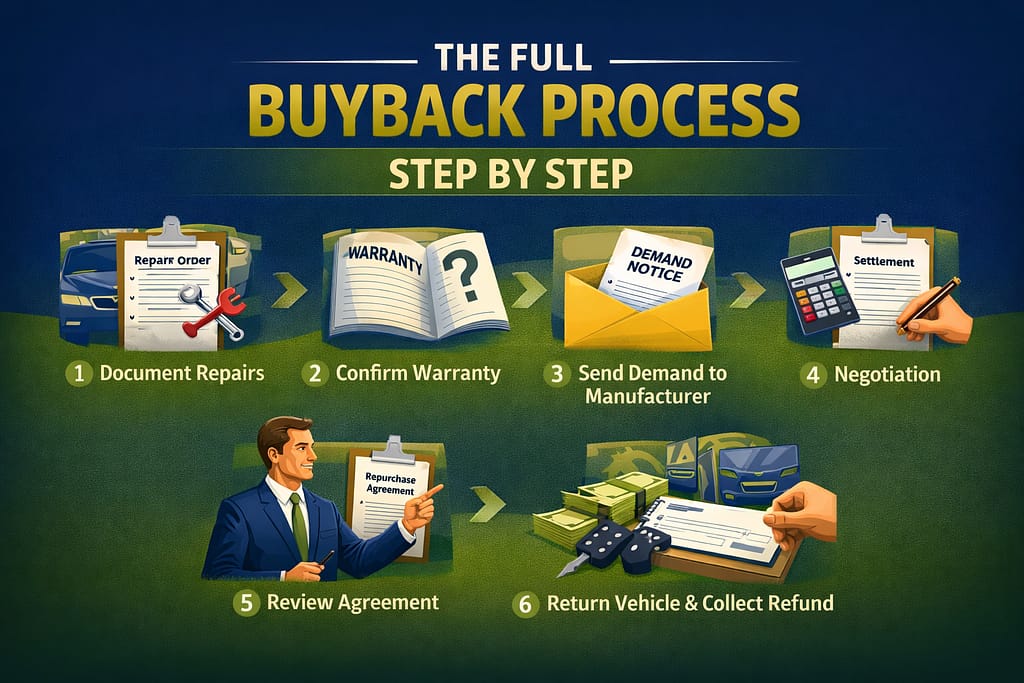
The lemon law buyback process has a defined sequence of steps. Skipping or mishandling any of them can delay your claim, reduce your payout, or under the 2025 AB 1755 changes, limit your ability to recover civil penalties. Once your vehicle qualifies, the buyback process typically follows a structured sequence:
- Document every repair visit from day one. Keep every repair order the dealer gives you. Record the mileage at drop-off and pickup, the symptom description, the diagnosis, the parts replaced, and the days out of service. This paper trail is your entire case.
- Confirm your vehicle is still under warranty. All qualifying repairs must have occurred during the manufacturer warranty period. If you are unsure whether your warranty is still active, contact the manufacturer directly and get the response in writing.
- Consult a lemon law attorney before sending any demand. Under AB 1755, a pre-litigation written notice to the manufacturer is required before seeking civil penalties. A California lemon law attorney will draft this notice correctly and ensure the required VIN, defect summary, and repurchase demand are all included.
- Send a formal written demand to the manufacturer (not the dealer). The dealer cannot approve a buyback on their own authority. Your demand must go to the manufacturer. Include your VIN, a complete repair history, and a clear statement that you are demanding a repurchase under the Song-Beverly Consumer Warranty Act.
- Give the manufacturer one final repair opportunity if requested. The manufacturer is entitled to one last attempt to fix the defect after receiving your demand. If they decline this opportunity or the repair fails again, they must proceed with the buyback.
- Review and negotiate the settlement offer. Do not accept the first number. Verify every component of the buyback calculation, confirm all incidental costs are included, and check the mileage offset against your actual repair records. Manufacturers routinely lowball initial offers.
- Review the manufacturer repurchase agreement carefully before signing. Check for release language, confirm loan payoff instructions are correct, verify the return deadline, and ensure the refund breakdown matches the negotiated terms.
- Return the vehicle and collect your refund. Bring all keys, owner’s manuals, charging equipment for Electric Vehicles, and original accessories. Remove all personal items. Factory reset the infotainment system. Turn in your defective vehicle and receive your refund check.
Timeline: How Long Does the Lemon Law Buyback Process Take?
The honest answer is that timelines vary widely depending on whether the manufacturer cooperates. Here is a realistic breakdown:
| Phase | Typical Duration | What Happens |
|---|---|---|
| Repair documentation | Ongoing before claim | Keep every repair order; track days out of service |
| Formal written demand to the manufacturer | 2-4 days to prepare | Notify the manufacturer in writing; include VIN, defect summary, and repair history |
| Manufacturer review period | 4-6 weeks | Manufacturer reviews records, and repurchase demand |
| Settlement negotiation | 2–8 weeks | Back-and-forth on buyback amount, mileage offset, and incidental costs |
| Paperwork and signing | 1–2 weeks | Review the settlement agreement carefully; do not sign until all terms are confirmed |
| Vehicle return and payment | 1-3 weeks | Return vehicle; the manufacturer pays the lender and issues your refund |
| Total (cooperative manufacturer) | 60-120 days | From formal demand to payment when the manufacturer does not dispute the claim |
| Total (disputed claim) | 6–18 months | When the manufacturer contests eligibility, valuation, or requires arbitration or litigation |
The single biggest factor in the timeline is whether the manufacturer accepts your documentation or challenges it. Manufacturers sometimes delay claims strategically, particularly for high-value vehicles. Working with a California lemon law attorney who handles volume claims against specific manufacturers often accelerates the process significantly. Manufacturers know which firms push back hard and which ones do not.
What Happens If the Manufacturer Disputes Your Claim?
Manufacturers dispute lemon law buyback claims more often than most consumers expect. Common grounds for dispute include: arguing the defect does not substantially impair the vehicle, challenging whether a sufficient number of repair attempts occurred, claiming consumer misuse or modifications caused the defect, and disputing the mileage offset calculation.
Arbitration
California’s Department of Consumer Affairs Arbitration Certification Program provides an alternative to litigation for disputed claims. Arbitration is faster and less expensive than court, but the decision is binding on the manufacturer if you win, and some manufacturers have opted into the new AB 1755 arbitration framework as their default dispute resolution path. Understanding what happens during lemon law arbitration before you enter the process is worth the time.
Litigation
If arbitration fails or is not appropriate for your situation, filing a civil lawsuit under the Song-Beverly Consumer Warranty Act is the next step. California law’s fee-shifting provision means the manufacturer pays your attorney’s fees if you prevail, making legal representation financially accessible for consumers with valid claims. Civil penalties of up to 2x the purchase price are only available through the litigation path, not through arbitration.
Manufacturers are also subject to federal warranty obligations under the Magnuson-Moss Warranty Act, which provides an additional legal avenue in cases where state law alone is insufficient or where the vehicle was purchased across state lines.
| Are Lemon Law Settlements Taxable? Whether your lemon law settlement is taxable depends on its components. The refund of your purchase price is generally not taxable. Civil penalty payments may be taxable as income. Compensation for physical injury or property damage may be excludable. This is a genuinely complex area that has tripped up many consumers, so it’s pertinent to review whether your California lemon law settlement is taxable before you file your taxes, and always consult a tax professional for guidance specific to your situation. |
AB 1755 (2025): Key Changes to the Buyback Process
California Assembly Bill 1755, effective January 1, 2025, made significant procedural changes to how lemon law buyback claims are handled. These changes apply to all claims filed on or after the effective date.
- Pre-litigation written notice is now required before seeking civil penalties. The notice must include your VIN, a description of the defect, your repair history, and a repurchase or replacement demand. The manufacturer has a set response window before you can proceed to court.
- New filing deadlines: Claims must be filed within one year of warranty expiration or within six years of original delivery — whichever comes first. This is stricter than many consumers assumed under the prior law.
- Accelerated discovery timeline: Once a lawsuit is filed, both parties may be required to exchange warranty and maintenance records within 60 days. A limited deposition must be completed within 120 days. Mandatory mediation must occur within 150 days.
- Manufacturer opt-in system: Some manufacturers may opt into a new alternative dispute resolution framework under AB 1755. Whether a manufacturer has opted in affects which rules apply to your specific claim.
Frequently Asked Questions
What is included in a lemon law buyback in California?
A California defective vehicle refund must include your original purchase price or total lease payments, down payment, sales tax, finance charges paid, and incidental costs such as towing and rental car fees caused by the defect. The manufacturer deducts a mileage offset calculated from your first repair visit mileage. Your outstanding loan is paid directly to the lender.
Can I get a lemon law buyback on a used car in California?
Yes, in many cases. Used vehicles still covered by the original manufacturer’s warranty or a Certified Pre-Owned warranty can qualify. The Rodriguez v. FCA US LLC ruling narrowed some used vehicle protections for non-CPO vehicles without active factory coverage, so warranty status is the determining factor.
Does the manufacturer have to offer a replacement instead of a buyback?
The manufacturer has the option to offer either a repurchase or a replacement vehicle. You do not have to accept a replacement if you prefer the buyback. In practice, most consumers take the buyback because it allows them to choose any vehicle from any brand rather than staying with the same manufacturer.
What if I owe more on my car loan than the buyback amount?
This is called negative equity. The manufacturer’s buyback obligation covers the vehicle’s purchase price minus the mileage offset, not necessarily your current loan payoff amount. If there is a gap, negotiate with the manufacturer to address it in the settlement or consult an attorney to explore your options.
Can the manufacturer deny my lemon law claim?
Yes, manufacturers can dispute claims. Common grounds are that the defect does not substantially impair the vehicle, that enough repair attempts were not given, or that the consumer caused the defect through misuse. A denial is not the end of the road; arbitration and litigation are both available paths, and the fee-shifting provision of California law means attorney representation costs you nothing if you prevail.
Do I need a California lemon law attorney for the buyback process?
You are not legally required to have one, but the data consistently shows that represented consumers receive larger settlements and faster resolutions. Because California law requires the manufacturer to pay your attorney’s fees when you win, legal representation is effectively free if your claim succeeds. A lemon law attorney from Court House Lawyers, with our legal background in manufacturer negotiations, can identify calculation errors, flag bad settlement terms, and push back on lowball offers that most consumers accept without questioning.
What happens to my car after the buyback?
The manufacturer takes title of the vehicle. Under California law, the vehicle must be branded as a “lemon law buyback” on the title before it can be resold. The defect must be repaired before the vehicle is sold again, and any new buyer must be clearly informed of the vehicle’s history.
Start Your Lemon Law Buyback with Confidence
If your vehicle qualifies, the manufacturer is legally required to pay. The only question is whether you recover the full amount you are owed and how smoothly the process is handled from start to finish.
At Court House Lawyers, we take a different approach than most lemon law firms. We do not take any portion of your settlement or buyback proceeds. When your vehicle is repurchased, the check is issued directly to you so you can move forward and secure a replacement without losing time and part of your recovery to legal fees.
We review your repair history, calculate your exact buyback value, and handle the entire process from demand to settlement. From negotiating with the manufacturer to reviewing the repurchase agreement, we make sure nothing is overlooked, and no money is left on the table.
No upfront costs. No hidden fees. No deductions from your recovery.
If you are ready to start your lemon law buyback, get a free case review today.